Why This Matters for Yarn Buyers
Many of us have grown used to ordering directly from small businesses in the UK, Canada, Australia, and beyond. These purchases have often arrived with no added fees, making it easy to support indie dyers from around the world.
Now, those same purchases could come with $80–$160 in surprise charges, even for a single skein or a $250 advent kit. That adds up quickly.
I want all my fellow knitters to be informed and prepared, not shocked when their advents show up with a bill.
What Can You Do?
Plan ahead financially for any international orders shipping after August 29th
Ask sellers whether they use couriers, ship DDP (Delivered Duties Paid), or plan to ship before the deadline
Consider combining purchases into one package when possible
Support your favorite dyers by spreading awareness; many of them are equally confused and frustrated
Subject to Change
This post is accurate as of early August 2025. Things could still shift due to court decisions, administrative updates, or international pressure. I’ll do my best to update you if that happens.
Until then, I hope this breakdown helps you make informed choices and avoid surprises. We all love our yarn, and we deserve to know what’s coming.
Let’s support our favorite dyers (and our budgets) as best we can.
Update: 8/11/2025
I came across a helpful comment from a licensed U.S. customs broker on Reddit who explained things from the courier side. Here’s what they said:
“Until August 29, 2025, orders under $800 won’t be charged tariffs or duty if shipped before that date (thanks to the de minimis exemption). After the 29th, both ‘tariffs and duty’ will be charged based on country of origin, and they’ll apply line-by-line. Courier shipments (like FedEx, DHL, UPS) don’t use USPS or flat fees - they charge a percentage based on where each item was made.”
UPDATE: 8/12/2025
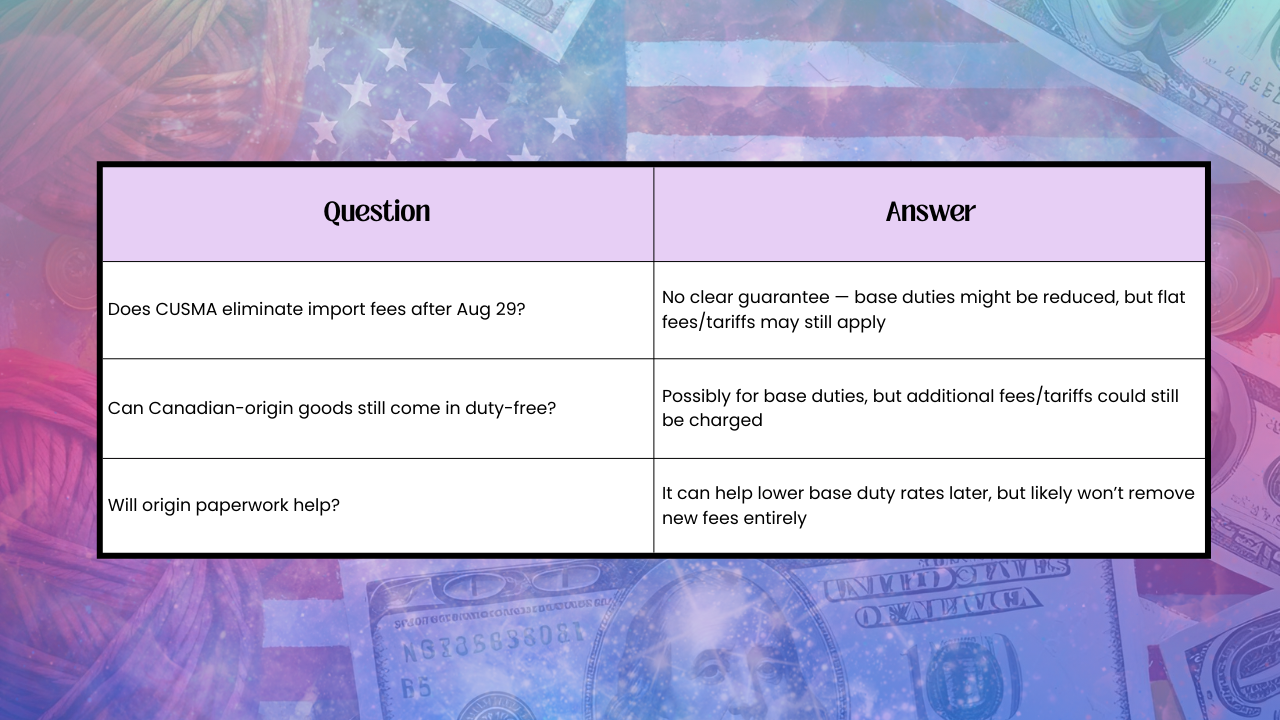
Recent sources, including CBC and USMCA/CUSMA trade summaries, indicate that goods meeting USMCA/CUSMA rules of origin may remain exempt from the new $80 flat fee and additional tariffs after August 29, 2025, at least for the time being. This means that yarn and other goods made in the US, Canada, or Mexico that qualify under the agreement and have proper documentation could still enter the US without these new fees.
However, the rules are complex, proof of origin will be required, and trade policies can change quickly. Because of this, the safest approach is still to prepare for possible added costs while hoping this exemption holds.
Update: 8/15/2025
Royal Mail has now confirmed that the US will no longer accept inbound packages without duties being paid in advance. As a result, some UK sellers, including certain yarn dyers, are switching to Delivered Duties Paid (DDP) shipping. This means the seller collects the estimated customs/duties at the time of shipping, so the package can be delivered without additional payment from the buyer upon arrival.
What this means for U.S. buyers:
If your seller uses Royal Mail with DDP, you may be invoiced by the seller for customs/duties before the package is sent.
This could replace the flat fee or ad valorem charge that would otherwise be collected at delivery — but the exact cost will depend on the package value and HS code.
If your seller is not using DDP, you may still be responsible for paying the new U.S. import fee (flat fee or percentage-based) when your package arrives.
We’re still waiting on concrete confirmation from US Customs on whether the $80–$120 flat fee will be waived for DDP shipments or if a different charge will apply. For now, the safest approach is to budget for the fee regardless and be pleasantly surprised if it doesn’t apply.
Update: 8/23/2025
In the past few days, more changes have come to light as businesses scramble to adapt to the new US import rules.
Canadian and UK dyers: A growing number of dyers in both Canada and the UK have announced that they are temporarily suspending shipments to the US until the impact of the new fees is clearer. This pause is meant to prevent surprise costs for their customers while they wait for more official guidance.
Polka Dot Creek (Canada) shared that they're shipping advents immediately to US customers in an effort to beat the August 29 cutoff and take advantage of the current de minimis exemption
Several independent shops, including Caterpillar Cross Stitch, have also reported that they’ve sent out US advent orders early to avoid potential surprises post–August 29
Many UK dyers are now requiring US customers to pay a 10% duty (based on the UK’s reciprocal tariff) at checkout. This reflects growing efforts to switch to Delivered Duties Paid (DDP) through Royal Mail's system.
However: don’t assume this avoids the flat USPS processing fee ($80–$120 during the transition period). According to both CBP and logistics experts, this flat-rate surcharge can still apply even when duties are prepaid, because it’s a separate “processing” charge, not a tariff.
Bottom line: Paying customs at checkout simplifies things - and may prevent additional ad valorem duties - but US buyers should still budget for the possibility of the flat import fee, unless their package ships via a courier or qualifies for full customs clearance.
Posten suspension: Norway’s Posten has temporarily suspended shipments to the US, as well. This directly affects personal orders from Knitting for Olive, a popular Danish yarn brand, meaning US knitters may not be able to order directly for the time being.
Craft shop workaround: On the other hand, Moon and Yarn Craft Room clarified that because they are a registered business, they can still import Knitting for Olive yarn for resale in the US. This suggests that local yarn shops might continue to act as an important bridge, even if direct consumer shipments are disrupted.
What this means for us as buyers:
It’s more important than ever to support our local yarn shops. They may be able to import brands that individual US customers currently can’t access directly. In the meantime, US knitters should plan for higher costs or longer delays on international purchases until the situation stabilizes.
How This Differs From EU Tariffs
I’ve seen a lot of comments from folks in the UK saying that what’s happening in the US just looks like what the EU has already been dealing with - and on the surface, that’s true. But there are some important differences that explain why US knitters and crafters are so alarmed.
EU De Minimis Threshold: The EU already has a much lower duty-free threshold (about €150 / $160 USD). Buyers there are used to smaller shipments being taxed or processed. The US, by contrast, had one of the most generous de minimis levels in the world at $800 - meaning most yarn orders slid in fee-free. Losing that suddenly feels like a much bigger change for us.
Fee Structure: In the EU, handling fees on small parcels are relatively modest (about €2 in some countries) plus VAT. In the US, we’re looking at a flat fee of $80–$120 per package during the transition period, which is disproportionately steep compared to the EU’s charges.
Shock Factor: For EU buyers, paying some form of VAT or modest duty on small packages is already normal. For US buyers, this shift represents a drastic change in cost expectations and predictability, especially for small orders like a skein or two.
The bottom line: The systems may look similar on paper, but the scale of the US flat fee and the sudden drop from an $800 threshold are what make it so disruptive here.